Create YouTube ideas from title patterns AI systems already cite
Use cited YouTube videos to understand which formats AI systems prefer, then turn those patterns into original title ideas and outlines for your own audience.
Why YouTube videos matter for AI visibility.
AI search results are not built only from written articles. For some topics, answer engines cite or mention videos because they explain a process, show a product, compare options, or give practical guidance. Further, with the flood of AI written articles, AI engines increasingly look for alternative sources which are still pre-dominantely written by humans.
In 2026 YouTube is the second most cited domain on Gemini and the 30th most cited domain on ChatGPT.
That makes YouTube a useful part of an AI search strategy. If videos already appear in answers for your category, they can show which topics, formats, and angles AI systems treat as useful.
This playbook helps you study those video patterns and turn them into original YouTube ideas for your own audience.
How does the YouTube playbook help to improve AI Search Visibility of my brand.
AI Search results are not built only from written articles. For some topics, AI systems cite YouTube videos.
That makes YouTube a useful part of an AI Search strategy. Reviewing videos that already appear in AI generated answers for your category, can reveal which questions, formats, and angles AI systems treat as useful.
Use this workflow to study cited YouTube videos, identify recurring title patterns, and turn the strongest patterns into original title ideas and outlines for your own audience.
GEO Playbook: How to create YouTube ideas from cited title patterns
To apply this playbook, start with AI Search results for your target prompts and review the YouTube videos that are cited in those answers. The goal is to understand which video formats and title patterns already perform well in AI generated answers, then use those patterns to create original title ideas for your own audience.
This workflow is useful when you want to plan YouTube content based on AI Search signals instead of relying only on internal brainstorming, keyword tools, or competitor channel research. Further it can be useful, when you publish existing video content on other platforms, like Instagram or TikTok, and want to re-use it to boost your visibility in AI Search.
Choose prompts where your audience needs more than a short written answer. Good examples include questions about how something works, which tools to compare, what mistakes to avoid, or how to solve a specific problem.
These prompts are more likely to surface YouTube citations because videos can explain, demonstrate, or compare something in a practical way.
Look at the YouTube URLs cited in answers from systems such as ChatGPT, Gemini, Perplexity, and other answer engines.
For each video, note the prompt that triggered it and the role it plays in the answer. Is it explaining a process, comparing options, reviewing a product, showing a walkthrough, or adding expert context? This shows where video content already supports AI generated answers in your category.
Prompt monitoring tools like ALLMO.ai provide a simple, organized view of all YouTube pages cited for your prompts. In addition, ALLMO.ai provides further data for each video, such as views, likes, channel information, and subscriber count.
Focus first on videos that are cited across several prompts, models, or high intent questions. These videos are stronger signals than videos cited only once.
A frequently cited video can show that AI systems repeatedly find the same format, title angle, or explanation useful. That makes it a better reference point for planning your own YouTube ideas.
Also check whether the cited videos come from competitors, creators, publishers, or independent experts. This helps you understand who currently owns video content authority for your topic.
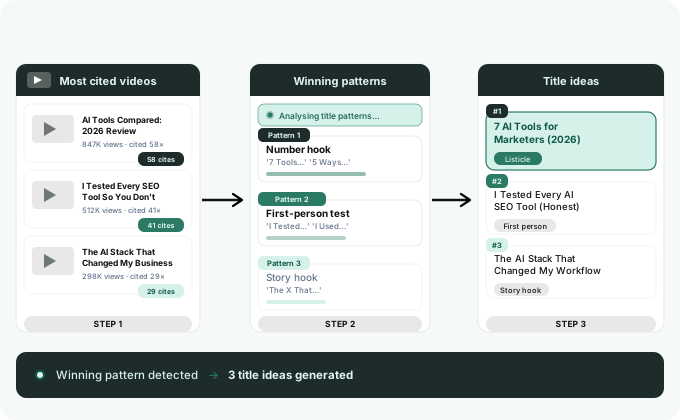
Group the cited video titles by structure. Common patterns include how to guides, best tools lists, beginner tutorials, product comparisons, mistakes to avoid, expert opinions, demos, and step by step walkthroughs. Focus on the format behind the title.
A title like “Best tools for X” is not only a title. It can be a signal that AI systems value comparison style content for that topic. A title like “How to do X” can signal that tutorial content is useful for informational-style questions.
The goal is to identify repeatable patterns, not to copy the wording.
Create new YouTube title ideas that use the strongest patterns while staying specific to your audience, product, and category. Strong ideas should be clear, searchable, and useful for people who do not know your brand yet. They should answer a real question, explain a clear problem, compare meaningful options, or help the viewer make a decision.
For each selected idea, add supporting context such as the target audience, the question being answered, the pattern identified, a short background, a possible outline, and the reference videos reviewed.
What to look for
Look for video patterns that appear across several prompts, models, or question types. A single cited video can be interesting especially if it matches recurring themes, but repeated citations are usually more useful for planning. Pay special attention to:
- Videos cited for high intent questions, such as comparisons, alternatives, best tools, tutorials, or buying criteria.
- Videos cited across more than one prompt or AI system.
- Titles that answer a clear question instead of only promoting a brand.
- Formats that appear repeatedly, such as how to guides, list videos, reviews, walkthroughs, and beginner explainers.
- Competitor videos that appear when your brand is missing.
- Creator or publisher videos that seem to shape how AI systems explain your category.
- Gaps where many written pages exist, but few strong videos answer the question well.
- Videos from accounts with few subscribers, and few views. They are easier to compete against, than bigger channels.
A useful pattern is one you can turn into a better, more specific, or more original video idea for your own audience.
How ALLMO helps you run this workflow
ALLMOs has a build-in GEO agent to identify youtube video titles from winning video patterns.
ALLMOs prompt citation intelligence feature automatically extracts all cited URLs from your prompt monitoring set. When YouTube videos are used as a source in answers from systems such as ChatGPT, Gemini, or Perplexity, ALLMO can show which videos were cited, how often they appeared, and which prompts triggered them.
The GEO agent automatically takes cited YouTube videos and identifies recurring title patterns, and turns these into YouTube title ideas for your company.
The output includes the suggested title, the pattern behind it, a short background, a possible outline, and the reference videos reviewed. You can apply the workflow manually, but ALLMO makes it easier to prioritize the videos that appear most often and connect the findings to the prompts, competitors, and topics that matter most for your AI Search visibility.
Key Benefits
- Find video formats AI systems already surface Use cited YouTube videos as a signal for which formats, questions, and angles appear in AI generated answers.
- Plan videos faster Turn observed patterns into clear YouTube title ideas.
- Plan videos from real discovery signals Turn repeated title patterns into clearer YouTube ideas instead of relying only on brainstorming or keyword tools.
- Align videos with user intent Use the suggested title, outline, background, pattern, and reference videos to brief your team or creator partners.
Who it's for
Use cited YouTube videos to identify formats, title structures, and angles that can become original video ideas.
Find video angles that support awareness, education, and category authority in AI driven discovery.
Use cited and mentioned videos as a signal for which content formats answer engines find useful.
Frequently asked questions
Is this only useful if we already have a YouTube channel?
No. It can also help you decide whether YouTube is worth investing in for your category.
Does this generate full scripts?
No. It focuses on video ideas, titles, and content angles. You can turn the strongest ideas into scripts or production briefs afterward.
How does this improve AI Search visibility?
YouTube is the second most cited domain on Gemini and the 30th most cited domain on ChatGPT. This helps you understand which video formats AI systems already use when answering questions in your category. You can use those patterns to create more relevant videos that answer similar questions, explain key topics, and support your broader AI Search visibility.
Which AI systems does this apply to?
This applies to AI systems that cite or reference external sources, including ChatGPT, Gemini, Perplexity, and similar answer engines. YouTube videos often appear when a visual explanation, tutorial, review, or walkthrough is useful.
Why use AI answer data for YouTube planning?
Because it shows which video formats already appear in AI generated answers. This gives you a different signal than YouTube search volume alone.
Should we copy existing video titles?
No. Use the title structures as inspiration, then create original titles and content for your own audience.
How often should we run this?
Run it monthly, quarterly, or whenever you plan a new batch of video content.
More playbooks
Keep building your AI visibility strategy with these next steps.
Check whether newly published pages are visible in AI search environments, so you can find discovery gaps before they affect performance.
Analyze the pages AI systems already cite, understand what page formats they prefer, and use those patterns to create new content to improve your visibility in AI generated answers.
Analyze metadata from frequently cited pages to understand how sites that shape AI answers are structured.