Engage on most cited 3rd party platforms
Use social media, online communities, and other UGC sources to find relevant conversations, draft helpful comments, and improve your brand's visibility in AI Search.
Why UGC and social conversations matter for GEO
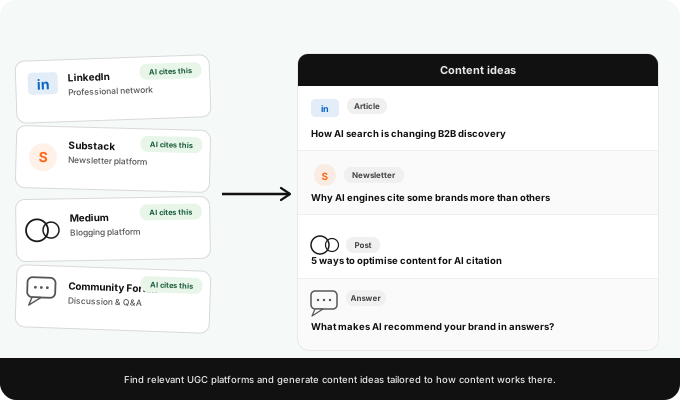
AI search does not only rely on brand websites. It can also use social media platforms, like LinkedIn, Pinterest and Facebook and other pages where users can create and upload content, including communities and online blogging sites like Substack and Medium.
These sources matter because they often contain real user language. People ask practical questions, compare alternatives, describe problems, challenge claims, and share experiences in ways that company pages often do not. Further, in the time of AI generated content, AI search models often prefer a communities moderated swarm intelligence over individual blog posts.
If your brand is absent from these discussions, AI systems may learn about your market from competitors, customers, reviewers, or community members without your perspective. Joining the right conversations can help you contribute accurate, useful information where people and AI systems may already be looking.
Plus, engaging in these conversations typically takes less time than drafting a new blog post for your website. Since the content is already being cited in AI answers, this also reduces the risk of investing time in the wrong places.
GEO Playbook: How to find and engage in cited UGC and social conversations
To apply this playbook, start with AI Search answers for your target prompts. Look at the cited sources and identify the pages that come from user generated content, social platforms, and other community based sources.
Then decide where your brand can add value. The goal is not to post everywhere or force brand mentions into old threads, but to find discussions where a transparent, useful contribution would improve the page for readers and give AI systems better external context about your category or brand.
The below steps focus on existing conversations, rather than creating new posts. If you are looking for guidance on creating new content on UGC sites, review the other playbooks.
Ask ChatGPT, or the AI model of your choice relevant prompts, a customer would ask, or review the list of citations in your Prompt Monitoring tool. ALLMO let’s you filter for UGC sites on it’s domain citation analytics feature.
Review the cited URLs and collect the sources that are based on user generated or social content.
Do not limit the review to large platforms. Some of the most useful opportunities come from smaller niche communities that are highly relevant in your industry, especially as they are often overlooked by other competitors.
Take the cited sources and focus on the ones that are mentioned most often. Other ways to prioritize include considering the importance of the prompt or checking whether the answer mentions a competitor but does not include your brand.
Next, check whether you can contribute to the conversations. On most UGC platforms, this is relatively simple because they rely on user engagement. In many cases, you only need to create a profile, which can be done in minutes and is still much faster than drafting a blog post.
Read the page before deciding what to post. Look at what the original user asked, what the existing replies say, and why the source may have been cited in an AI answer.
Identify whether the discussion is about alternatives, troubleshooting, buying criteria, pricing, implementation, product fit, category education, or first hand experience.
The better you understand the intent, the easier it is to write a comment that is useful instead of promotional.
Before drafting a comment, check whether your brand already appears in the discussion. Also check whether competitors are mentioned, whether the information is accurate, and whether important context is missing.
If your brand is missing but relevant, a helpful comment may add useful context. If your brand is already mentioned, you may not need to mention it again. In some cases, it is enough to agree with the original comment, add an example, clarify a detail, or reinforce the useful information that is already there.
This step helps avoid repetitive or forced brand mentions.
Prioritize discussions where your team can add clear value. Good opportunities are relevant, accessible, specific, and connected to a real question or decision.
Check whether replies are still possible, whether the thread is active enough to matter, whether the platform allows brand participation, and whether your connection to the brand should be disclosed.
Skip pages where comments are closed, the discussion is outdated, the topic is only loosely related, or brand participation would feel forced. Quality matters more than volume.
Create a comment for each selected platform. The comment should match the discussion, respect platform rules, and be useful even if the reader does not care about your brand.
Use the comment to add context, examples, corrections, comparisons, or resources. Mention the brand only when it is directly relevant and helpful. Disclose your connection when needed.
Before posting, manually review the page, the thread context, and the suggested comment. AI can do a quick check, but it can miss closed threads, changed context, moderation rules, or subtle tone issues. The final decision should stay with a human.
What to look for
Finding the right places to engage requires filtering out the noise and zeroing in on high-value discussions. To identify the best opportunities for your brand, focus on these key indicators:
- High-Intent Conversations: Look for discussions where users are actively comparing vendors, describing pain points, challenging claims, or asking for recommendations and buying criteria.
- Frequently Cited Sources: Prioritize pages and links that are repeatedly referenced across multiple prompts, AI models, or high-intent questions, as these indicate a stronger foundational opportunity.
- Clear Content Gaps: Target threads where competitors are mentioned but your brand is missing, where users face a problem your product directly solves, or where existing answers are outdated, incomplete, or misleading.
- Niche and Industry Platforms: Don’t limit your search to giant social networks. Valuable citations often come from trade forums, specialist directories, niche product communities, or industry-specific applications.
- Engagement Viability: Before participating, evaluate the thread’s age, check if replies are still open, review the platform’s rules, and determine if you need to disclose your brand alignment.
Ultimately, the goal is to make a meaningful contribution rather than just adding to the clutter. If jumping into a conversation feels forced, promotional, or unnatural, it is always better to skip it and move on to a better fit.
Key Benefits
- Find relevant discussions Identify external conversations that already appear in AI cited sources.
- Improve off page visibility Take part in the wider knowledge environment that AI systems may use to form answers.
- Save time Writing a comment on existing content that is already cited in AI answers is typically much faster than creating new content from scratch.
How ALLMOs GEO agent runs this workflow automatically
ALLMO’s GEO agents run this workflow automatically. The agents analyze AI search results for your target prompts, collect cited sources, categorize all cited pages by source type, and identify UGC, social, community, and niche platform opportunities.
This matters because ALLMO is not limited to a fixed list of platforms. The system categorizes the sources that actually appear in AI answers. This helps surface communities specific to your industry, niche applications, and specialized platforms that a generic UGC workflow might overlook.
For each relevant platform, ALLMO creates a UGC engagement brief. The brief includes the platform, the cited page, the conversation context, and a suggested comment your team can review and post.
Each week, you get a list of prioritized opportunities. All you need to do is open the link, copy the suggested comment, and post it. ALLMO’s agents deliberately do not cover the posting step, both to keep a human in the loop and because most platforms disallow bot posting.
ALLMO can also run a quick check to see whether participation appears possible and whether your brand is already mentioned. This check helps with prioritization, but it is not a replacement for human review. Before posting, your team should still open the source, review the discussion, check the platform rules, and decide whether the suggested comment is appropriate.
Who it's for
Use this playbook to find third party conversations that may influence how AI systems explain your category, competitors, and brand.
External conversations show real questions, objections, comparisons, and use cases. Use this method combining AI Search and Social Listening to guide both community engagement and content planning.
Use cited UGC pages as an off page visibility signal. This helps you see which external sources may influence AI search results in your category.
Frequently asked questions
Does this create new content?
This playbook focuses on joining existing conversations. If you want to create new posts on third party platforms, use a publishing focused UGC playbook instead.
Should every comment mention the brand?
No. Mention the brand only when it is directly relevant and helpful. In many cases, a useful answer, clarification, or resource may be more appropriate than a brand mention.
Is this safe for brand reputation?
Yes, if it is done manually, transparently, and respectfully. Follow platform rules, disclose your connection when relevant, and avoid promotional or misleading comments.
Should I still comment, if a UGC conversation already mentions my brand?
Yes, AI models use engagement like comments and upvotes as quality signals. By engaging here, you further boost the authority of content where your brand is positioned.
Does this create new content?
This playbook focuses on joining existing conversations. If you want to create new posts on third party platforms, use a publishing focused UGC playbook instead.
How often should we review opportunities?
Weekly or monthly is usually enough, depending on how active your category is and how often new AI search answers cite fresh external sources.
Does this only support large platforms like Reddit or Quora?
No. The workflow can work with any platform that appears in AI Search citations. This is important because AI systems often cite niche communities, industry forums, local platforms, and specialized review sites that generic playbooks overlook.
More playbooks
Keep building your AI visibility strategy with these next steps.
Check whether newly published pages are visible in AI search environments, so you can find discovery gaps before they affect performance.
Analyze the pages AI systems already cite, understand what page formats they prefer, and use those patterns to create new content to improve your visibility in AI generated answers.
Analyze metadata from frequently cited pages to understand how sites that shape AI answers are structured.