
How to Use Query Fan-Out to Identify the Exact Search Terms AI Models use
Find content ideas by analyzing the research queries AI systems use when generating answers.
Why anaylzing AI query-fan-out helps with optimization
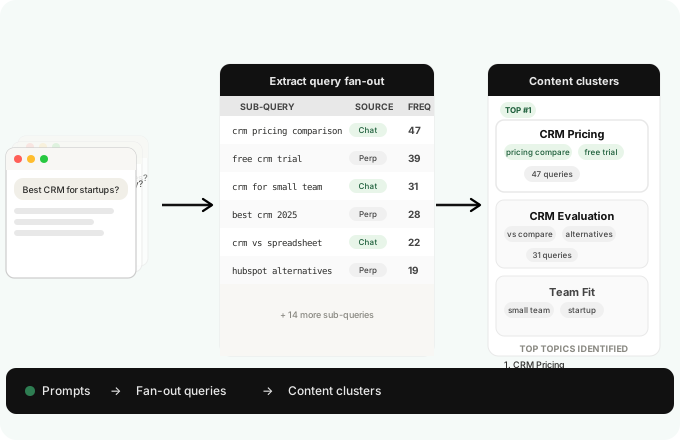
AI Search rarely works like a single keyword search. When someone asks a question, AI systems may break the prompt into several smaller research tasks. They may look for definitions, compare alternatives, check use cases, review pricing signals, search for proof, or gather context before generating an answer.
Those follow up searches are called query fan-out. They are useful because they reveal what AI systems appear to research before they answer questions in your market.
If the same fan-out queries appear again and again, they become strong content signals. They show which topics AI systems may need to understand before they can explain a category, recommend a solution, or mention a brand.
If your website does not cover these supporting topics clearly, AI systems may rely on competitors, publishers, directories, forums, or review sites instead. Query fan-out helps you spot those gaps and turn them into grounded content ideas.
GEO Playbook: How to find content topics AI systems are looking for
To apply this playbook, start with the fan-out queries behind your AI Search prompts. Many GEO tools show the exact fan-out queries per prompt. ALLMO also shows them in the Query Fan-Out feature.
Raw fan out queries are the starting pointt. The goal is to cluster repeated query patterns into content opportunities. A strong output is not just a list of queries.
The goal is not to publish more generic SEO content. The goal is to understand what AI systems repeatedly research, then create or improve content that answers those topics clearly.
Choose the prompts, tags, language, market, or customer segment you want to analyze.
Start with prompts that reveal commercial or strategic visibility gaps, such as comparison prompts, alternative prompts, buying intent prompts, use case prompts, category explanation prompts, or prompts where competitors appear more often than your brand.
Then review the fan-out queries connected to those prompts. Look for the questions AI systems appear to research before they answer, and note them down.
Look for follow up queries that appear repeatedly across prompts, models, or customer segments. Repeated queries often show what AI systems need to understand before they can answer confidently.
Pay attention to patterns such as definitions, category explanations, product comparisons, feature questions, pricing questions, implementation questions, industry specific use cases, trust signals, certifications, and proof points. Further, check for typical structures e.g. “Best tool for xyz” or “How to do abc”. In additon, it’s also worth checking for words that AI ads most often to query fan-outs.
Group related queries into broader content and semantic themes. Several smaller questions may belong in one strong article instead of becoming separate pages.
For each cluster, decide what type of content would answer the topic best. Common options include guides, comparison pages, category explainers, use case pages, feature pages, glossary entries, buying guides, FAQ sections, or new sections on existing pages.
A good recommendation should include more than a title. Add context for the writer or writing agent, explain why the topic looks promising, and keep the source queries attached so the idea stays grounded.
For every topic, ask whether you already answer it clearly, whether the answer is easy to find, whether the content is specific enough, whether competitors explain it better, and whether the topic should become a new article, an updated section, or an FAQ.
Create headlines that are semantically aligned with the query fan out, so AI search engines are more likely to consider your content relevant.
This step is important. Query fan-out can produce useful ideas, but you should not create duplicate content just because a topic appears in the data. If you already have a relevant page, improve that page instead.
Turn each strong opportunity into a practical brief. Include the recommended article title, target audience, search intent, suggested format, context for the writer or writing agent.
Use the source queries to draft an initial outline with H1, H2, and H3 sections. The outline should reflect the query patterns, but the final article should still add your own expertise, examples, data, and point of view.
After publishing or updating content, recheck your AI Search prompts. Look for changes in brand mentions, cited domains, cited pages, and the topics AI systems use in their answers.
Key Benefits
- Find AI search topics Identify topics AI systems research when answering questions in your market.
- Focus on repeated demand Identify and prioritize search queries that appear across multiple prompts, and models.
- Align content semantically with AI Search Align your headlines and content with the way AI systems search, so they can recognize its relevance.
Who it's for
Use this workflow to understand which supporting questions AI systems investigate before generating answers in your category.
Use query fan out patterns alongside keyword research, rankings, competitor analysis, and search intent data.
Use recurring AI research paths to identify articles and page updates that can support visibility, education, and conversion.
What to look for
The strongest opportunities usually appear when the same topic shows up across several prompts, models, or customer questions.
Look for topics where AI systems repeatedly research the same question before answering relevant prompts. Also look for topics that appear across different models, involve competitors, connect to buying criteria, or are explained better by cited pages than by your own website.
Further, compare query fan-out against the cited sources. If there is a big difference, it means there is a gap to create an article which is closer alignd with what AI actually seraches for.
How ALLMO runs this workflow
With ALLMO, you can see the exact fan out queries for each prompt. A GEO Agent in ALLMO automatically executes this playbook every week, analyzes those queries, and generates clustered content recommendations.
The output is a table with a recommended article, context for your agent, background on why the recommendation looks promising, and the source queries reviewed. You can see which content ideas are grounded in repeated fan out queries, why they matter, and what a writing agent should focus on.
This means you can automatically apply this playbook without any prior GEO knowledge and write content optimized for ChatGPT.
ALLMO does not automatically publish anything to your website. You can still review the content recommendations and write articles that match your brand identity and writing style.
Frequently asked questions
How is this different from keyword research?
Keyword research starts with what people type into search engines. Query fan out analysis starts with what AI systems appear to research when forming answers.
Both are useful. Keyword research helps you understand search demand. Query fan out analysis helps you understand the supporting questions AI systems may use to build an answer.
How does this improve ChatGPT visibility?
AI systems need clear information to understand a topic, compare options, and decide which brands or sources are relevant. If your website answers the supporting questions that appear repeatedly in AI research paths, it gives AI systems more useful material to work with.
This does not guarantee a mention, but it can improve your topical coverage and make your content more useful for AI generated answers.
Should every fan out query become its own page?
No. Many fan out queries should be grouped into one stronger page.
Create a separate page only when the topic has enough depth, clear intent, and value for the reader. If the query is narrow, consider to use it as a section, FAQ, heading, or supporting paragraph inside a broader page.
Can I use the source queries to create an outline?
Yes. Use the source query patterns to draft an initial outline with H1, H2, and H3 sections.
The outline should reflect what AI systems repeatedly research, but the final article should add your own expertise, examples, data, and point of view.
How often should I repeat this workflow?
Run it weekly or monthly, depending on how often you collect new AI Search prompt data.
You should also repeat it after adding new prompts, entering a new market, changing positioning, launching a new feature, or seeing new competitor patterns.
Does this only work with ALLMO?
The general workflow can be done manually if you have access to query fan out data. There are plenty of tools available, that help you with this.
ALLMO's Query Fan Out feature shows the raw fan out queries, while the GEO Agent in ALLMO applies this playbook and turns those queries into clustered content recommendations with a recommended article, context for your writing agent, background, and source queries.
More playbooks
Keep building your AI visibility strategy with these next steps.
Check whether newly published pages are visible in AI search environments, so you can find discovery gaps before they affect performance.
Analyze the pages AI systems already cite, understand what page formats they prefer, and use those patterns to create new content to improve your visibility in AI generated answers.
Analyze metadata from frequently cited pages to understand how sites that shape AI answers are structured.