Get New Pages Discovered by AI
Add newly published pages to an AI discovery workflow so they can be found, crawled, and evaluated faster by AI search systems.
Why getting your new pages discovered by AI models matters
Publishing a page does not mean AI search engines will find it quickly. A new URL can be live on your website, visible to users, and still not appear in ChatGPT or Perplexity for some time.
That delay matters most when the page is tied to revenue, hiring, launches, or time sensitive demand. If AI only discovers a new feature page after two weeks, that is two weeks where people asking relevant questions may not see your latest product information. If a job advert is only public for 14 days, late discovery can mean the page misses the entire window.
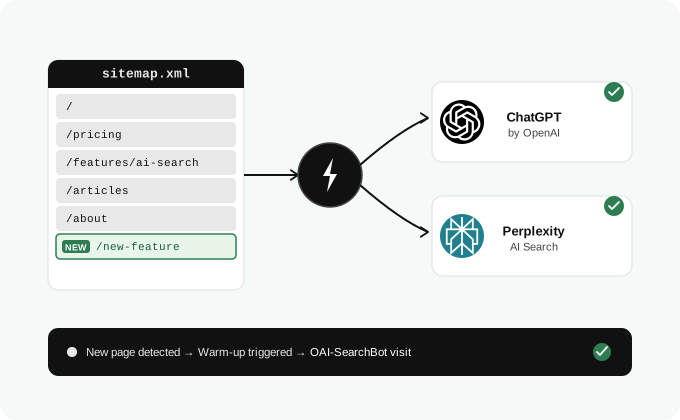
A structured new page discovery workflow closes this gap. Instead of manually checking your sitemap and triggering warm-up URL by URL, connect sitemap changes to AI warm-up. When a new page appears in the sitemap, it can be added to the discovery workflow automatically.
GEO Playbook: How to get new pages discovered by AI Crawlers
Every time you publish a new page, treat discovery as part of the publishing process. The goal is simple: make sure ChatGPT and Perplexity can find the page, understand what it is about, and use it as a source when it is relevant.
Manually, this means taking the new URL, testing it in ChatGPT and Perplexity with relevant prompts, and checking whether the page appears as a citation. You can also review crawler logs to confirm whether an AI bot has visited the page. If you update the page later, repeat the same process so AI systems can discover the updated version.
ALLMO helps automate this workflow. Once your sitemap is connected and the agent is active, new URLs are detected automatically and added to warm-up for ChatGPT and Perplexity, as long as credits are available.
GEO Playbook: How to get new pages discovered by AI
Use this workflow every time you publish a new page that should be discoverable in ChatGPT or Perplexity. It is especially useful for time critical pages, such as feature launches, campaign pages, event pages, job adverts, product pages, comparison pages, and important content updates.
Or use ALLMOs Warm-up Agent. The result is a reliable, repeatable process: publish a page, and ALLMO handles the discovery step without any manual intervention on your part.
Every time you create a new page, make discovery part of the publishing process. Do not wait and hope that AI systems will find the page eventually. Take the new URL, open ChatGPT and Perplexity, and input the page directly. Then ask relevant questions about the page, the topic, the product, the use case, or the offer until the page appears as a citation.
With ALLMO, this step starts automatically once your sitemap is connected and the agent is active. ALLMO checks your sitemap for new URLs and adds newly discovered pages to the warm-up workflow as long as credits are available.
Do not only ask whether the URL exists. Ask the kinds of questions your audience would ask when the page should be relevant. For a new feature page, ask about the problem it solves, the use case, and implementation details. For a job advert, ask about the role, location, requirements, and company. The goal is to test whether ChatGPT and Perplexity can connect the page to real AI Search prompts, and it ensures that AI systems use more crawling budget on the page to fully parse it’s content.
ALLMO’s warm-up agent handles this with multiple prompts around the new page. Instead of checking the URL once, the agent pings ChatGPT and Perplexity with different prompt variations until the page appears as a citation in a prompt.
After you have tested the URL in ChatGPT and Perplexity, check your crawler logs or server logs. Look for signs that an AI-related bot visited the page. This helps you understand whether the page was only tested in the interface, or whether an AI crawler actually accessed it.
With ALLMO, you can review the warm-up result on the warm-up page and see whether the URL was found or not found. If you also have access to crawler logs, use them as an additional verification layer to confirm whether AI bot activity happened after warm-up.
Discovery is not only relevant when a page is first published. If you update the page with important new information, repeat the same process. Otherwise, AI systems may continue to rely on an older version of the page or pick information from other sources.
With ALLMO, the new page discovery agent focuses on URLs newly found in your sitemap. For major updates to existing pages, treat warm-up as a follow-up step and run it again when the updated page should be rediscovered by ChatGPT and Perplexity.
How ALLMO runs this workflow
ALLMO monitors your connected sitemap every 3 hours. When a new URL appears, ALLMO detects the change and triggers the warm-up workflow for ChatGPT and Perplexity, as long as warm-up credits are available.
This removes the manual step that existed before. Users no longer need to notice every new page, copy the URL, and start warm-up for each page separately. Instead you get AI discovery on autopilot.
The result is visible in the standard warm-up workflow. Users can review whether each URL was found or not found, just as they can when starting warm-up manually.
In the current version, ALLMO processes every new sitemap URL. A future version will add URL pattern filters, for you to decide which sections should be included automatically.
Key Benefits
- Faster discovery process New pages are added to an AI discovery workflow shortly after publication.
- Less manual checking You do not need to manually review or submit every new URL.
- Stronger publishing workflow Make AI discovery a standard step after publishing important content.
Who it's for
You publish new pages regularly. This workflow helps make sure they are detected from your sitemap and added to warm-up without manual submission.
Managing multiple content types across a growing site means you can't check every URL manually. This playbook makes AI discovery automatic.
Pages tied to campaigns and product launches need to be discoverable immediately. This playbook closes the gap between going live and appearing in AI answers.
Frequently asked questions
Does this work for pages not yet in Google's index?
Yes. AI discovery and traditional search indexing are separate processes. ALLMO's warm-up activity targets AI search systems directly, regardless of whether a page has been indexed by traditional search engines.
How quickly are new pages detected after publication?
Detection depends on how often your sitemap is refreshed. Pages appear in the detection queue once they are visible in your sitemap. For most CMS platforms, this happens within minutes to a few hours of publication.
How does this improve ChatGPT and Perplexity visibility?
ChatGPT and Perplexity need to discover a page before they can use it in AI Search results. This workflow reduces the delay between publishing a page and starting warm-up activity for that page.
Can I use this alongside other ALLMO playbooks?
Yes. This playbook focuses specifically on the moment of publication. You can combine it with visibility monitoring and citation tracking playbooks to build a complete picture of how each page performs across AI search environments over time.
More playbooks
Keep building your AI visibility strategy with these next steps.
Check whether newly published pages are visible in AI search environments, so you can find discovery gaps before they affect performance.
Analyze the pages AI systems already cite, understand what page formats they prefer, and use those patterns to create new content to improve your visibility in AI generated answers.
Analyze metadata from frequently cited pages to understand how sites that shape AI answers are structured.