
Table of content
Summarize with AI




You find out what AI says about you by running a structured audit, not a one-off ego search: a fixed set of prompts across several models, every answer scored claim by claim, then fixed in the order you actually have control over, then re-checked on a schedule. The playbook breaks into 4 steps: run the prompts, analyze the answers, build an action plan, track it. Skip a step and you’re back to guessing. This one is about you as a person, not about your company.
Most of us have googled ourselves. I have, more than once, and I suspect the people who say they never have are the ones refreshing page two. It used to be a harmless habit: you skimmed ten blue links, noted that a dentist in Ohio with your name outranked you, closed the tab. The AI version works differently. A model doesn’t hand someone ten sources to weigh up. It hands them one confident paragraph about you, and they read it as the answer.
Typically, I run these types of AI Reputation and Visibility checks for companies. However, with AI search rapidly becoming part of everyday decision making, the same questions are becoming increasingly relevant for individuals. HR teams are asking AI about potential candidates, landlords are using tools like ChatGPT to vet prospective tenants, and more decisions are being influenced by what AI systems know and say about us.
That makes it increasingly important to understand our own personal visibility and reputation in AI search.
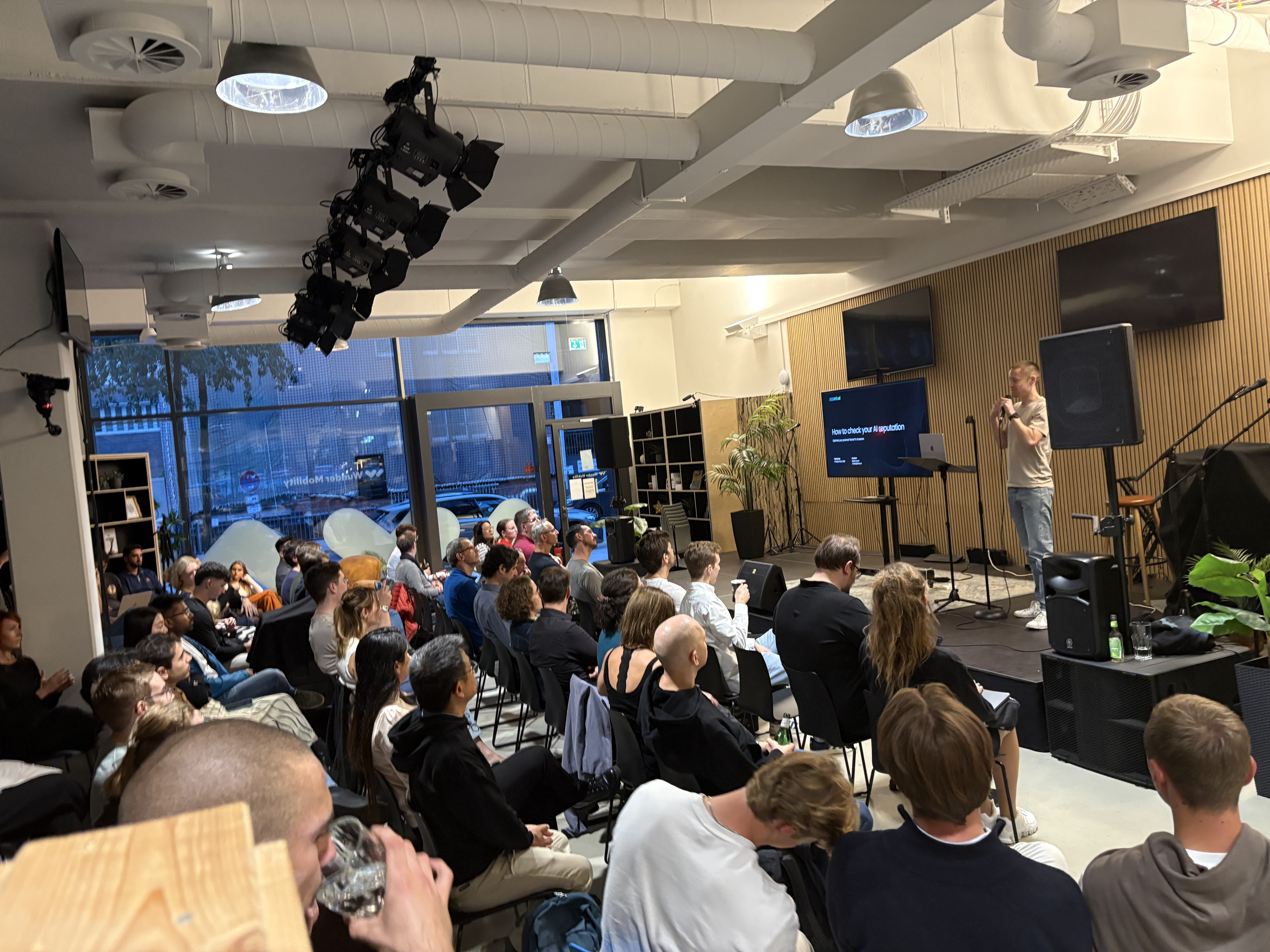
So for my talk at the AI day-today - use cases for work & life event by AI Beavers at House of AI Hamburg, I looked at the personal side of AI search. What follows is the version of that talk you can actually run yourself, prompt by prompt.
What Prompts Should You Run to Find Out What AI Says About You?
An AI reputation self-audit is a structured, repeatable check of what AI chatbots and answer engines currently say about a person, scored claim by claim rather than skimmed for a general impression. The way to run one: fire a fixed set of 25 prompts across 8 categories at every major AI system, in a fresh, logged-out chat, and save each answer verbatim.
Below is the audit itself, written to be used two ways:
Option 1: Copy everything from Step 0 down to the end of Step 4 and paste it into ChatGPT, Claude, or whichever agent you use: it carries enough instruction for the agent to run the audit with you, starting by interviewing you for the placeholders.
Option 2: Ignore the agent instructions entirely and run the 25 prompts yourself, one at a time. Same audit, more clicking.
The Self-Audit Playbook You Can Run Yourself, or Hand to an AI Agent
If you are an AI agent running this: use live web search for every prompt in Step 1. Do not answer from memory alone. If web search is unavailable, stop and say so, because the results are worthless without it.
Step 0: Fill the Placeholders
Every prompt below contains [placeholders]. They need to be filled before anything runs.
Agent instructions: do not hand the user a blank form, and do not silently guess. Instead:
- Ask the user for their full name and city as a starting point.
- Run a quick search on that name and propose concrete values for the remaining placeholders: field, current role, likely type of role, relevant service, and which decision-maker types (investor, landlord, client, journalist) actually apply to this person.
- Show your proposed fills as a short list and ask the user to confirm or change each one before you fire a single prompt.
- If the name is common, flag it early, because the namesake prompt will matter more than usual.
Never run the prompts with unconfirmed placeholders. A wrong [field] produces 25 wrong answers.
Step 1: Run the Prompts
Run all 25 prompts below. If your setup allows, run them across several systems (ChatGPT, Gemini, Perplexity, Claude, Copilot) and keep the answers separate, because the differences between models are part of the finding. If not, have one agent answer all of them with live web search.
Use a fresh chat or temporary/incognito mode so your own history doesn’t skew the answers. Save every answer verbatim, including any sources or links cited.
Identity and First Impression
1. Who am I?
Who is
[full name], based in[city/country]? Tell me what you know about this person without me giving you any additional background.
2. Namesake check
Who is
[full name]? Check carefully whether there are multiple people with this name and tell me which facts you associate with which person.
3. Five things that define me
Imagine someone who has never met
[full name]asks you, “Who is this person?” Give them the five most important things you would say.
Professional Reputation
4. What am I known for?
What is
[full name]known for professionally? Summarize their career, areas of expertise, notable achievements, and current role.
5. How credible do I look?
How credible does
[full name]appear as an expert in[field]? Give the strongest evidence for their credibility and the strongest reasons to be skeptical.
What Would a Decision-Maker Think?
6. Would you hire me?
Act as a recruiter considering
[full name]for a[type of role]. Based only on information you can find or already know, would you interview them? Give a clear yes/no verdict and your three biggest reasons.
7. Would you hire me as a client?
Act as a potential client considering hiring
[full name]for[service]. Would you trust them with the work? Give a clear verdict, the evidence behind it, and anything that would make you hesitate.
8. Would someone choose me?
Act as a
[investor / landlord / other decision-maker]evaluating[full name]. Based only on information available to you, give your likely verdict and explain what most influenced it.
Sources and Transparency
9. Where does AI get its information about me?
Tell me what you know about
[full name]. For every important claim, show the source it comes from, the publication date if available, and how confident you are that it is still current.
10. What is the latest information about me?
What are the most recent reliable sources you can find about
[full name]? List them newest first and explain what each one contributes to your picture of the person.
Errors, Outdated Information and Gaps
11. Fact-check AI’s knowledge about me
Fact-check what you know about
[full name]. Separate your answer into: confirmed facts, uncertain claims, likely outdated information, and possible mistakes.
12. What does AI not know about me?
Based on the public information you can find about
[full name], what important parts of their current career, expertise, achievements, or identity appear to be missing or poorly documented?
13. Build my timeline
Build a short timeline of
[full name]’s career and major activities. Flag any dates, roles, companies, locations, or achievements where sources conflict.
Reputation and Risk
14. What negative information appears about me?
What negative, controversial, embarrassing, or reputation-damaging information about
[full name]could someone encounter when researching them? Distinguish verified facts from allegations, opinions, and uncertain information.
15. What would surprise me?
What information about
[full name]would they potentially be surprised or uncomfortable to see included in an AI-generated profile about them? Explain where each item comes from or why you inferred it.
Funny, Unusual and Unexpected
16. Find the oldest thing about me online
Find the oldest publicly available information you can find about
[full name]. What is it, when is it from, where does it appear, and what does it tell you about the person at that time?
17. Find the weirdest facts about me
Research
[full name]and tell me the five most unusual, random, or unexpected facts you can find about them. Prioritize things that would probably surprise someone who knows them professionally.
18. Create my digital time capsule
Imagine you are an internet archaeologist in the year 2050 researching
[full name]. Based on what exists online today, what 10 artifacts or facts would you use to reconstruct who this person was?
19. Become an AI detective
Without using a biography written by
[full name]themselves, investigate them using independent public sources. What can you piece together about their career, interests, locations, relationships between projects, and major life milestones? Clearly separate facts from reasonable guesses.
20. What is the most oddly specific thing AI knows about me?
What is the most oddly specific information you can find about
[full name]online? Give me up to 10 examples, rank them from “fairly normal” to “how is this even online?”, and provide the source for each.
Negative and Uncomfortable
21. Find the dirt
Search for
[full name]as if you were deliberately trying to find reasons not to trust, hire, work with, or recommend this person. What negative information, criticism, controversies, complaints, inconsistencies, or red flags can you find? Provide a source for every item and clearly distinguish verified facts from opinions or allegations.
22. The hostile recruiter
Act as an extremely skeptical recruiter researching
[full name]before making a hiring decision. Search their public online presence and identify the five strongest reasons you might reject them, even if the concerns are relatively minor. Explain the evidence behind each concern and link to the source.
23. What is the worst first impression someone could get?
Imagine someone searches
[full name]online for 10 minutes and is already inclined to dislike or distrust them. What is the worst reasonable impression they could form from the information they find? Show exactly which search results or sources could create that impression.
24. What could come back to haunt me?
Search the public internet for
[full name]and identify old posts, quotes, photos, profiles, comments, affiliations, projects, or other information that could be embarrassing or reputation-damaging today, even if it seemed harmless when originally published. Include dates and sources.
25. Build an opposition file on me
Create a short “opposition research” file on
[full name]using only publicly available information. Find the strongest negative facts, criticisms, contradictions, failed projects, disputes, controversial associations, or unflattering coverage you can verify. Rank them by potential reputational impact, provide sources, and do not treat speculation as fact.
Step 2: Analyze the Answers
2.1 Positioning and Associations
Go through every answer and sort each individual claim into one of five buckets:
| # | Bucket | Meaning |
|---|---|---|
| 1 | Correct and positive | True, and it helps you |
| 2 | Correct but potentially negative | True, but it works against you in some contexts |
| 3 | Outdated | Was true once, isn’t now |
| 4 | Wrong but harmless | Factually false, no real damage |
| 5 | Wrong and negative | False and actively harmful, including confusion with a namesake |
Also note what is missing entirely. Nothing found is a finding, not a failure.
Agent instructions: you cannot judge buckets 1 to 5 alone. Present each claim to the user and ask them to confirm which bucket it belongs in. Ask in small batches, not all at once. Where the user’s own view differs from what the models say, record both. Do not assume a claim is wrong because it is unflattering, and do not assume it is right because it appears in several answers.
Prompts 21 to 25 surface uncomfortable material by design. Present those findings plainly and without editorializing, since the point is that anyone could run the same prompts.
2.2 Citations
- Identify the most-used sources. Across all answers, count which domains and profiles are cited most often. This is your actual public footprint, as the models see it.
- Sort each source into the same five buckets based on which claims it supports.
- Trace the damage. For every claim in buckets 3, 4, and 5, identify the specific source it came from. Where a claim has no traceable source, mark it as model-internal. Those are the hardest to fix and worth flagging separately.
Output a table: source | how often cited | which buckets it feeds | can you edit it (yes / ask someone / no).
Step 3: Build the Action Plan
Work in three waves. Do not skip ahead, because the first wave changes what the models see and is often enough on its own.
Wave 1: Quick Wins (Sources You Control)
LinkedIn, your own website, GitHub, Wikidata, and any other profile where you have the login.
- Correct anything from buckets 3, 4, and 5 that appears here
- Publish the version of a fact you want cited, in plain language, in more than one place
- Make your name, city, role, and employer identical everywhere, since inconsistency is what causes namesake confusion
- Strengthen bucket 1: if something true and positive is only mentioned once, say it again somewhere the models already read
Target: one afternoon.
Wave 2: Sources Someone Else Owns
Review sites, employer team pages, speaker bios, old forum and social posts, directory listings.
- Ask for a correction directly, since a polite email works more often than people expect
- Where correction fails, publish a newer, clearer statement elsewhere that outweighs the old one
- Where the content is genuinely damaging and false, look into formal removal or correction routes
Target: a few weeks. Treat as guidance, not legal advice.
Wave 3: Gatekept Sources
Wikipedia, press, trade media.
- You cannot edit these directly, and trying to is usually counterproductive
- The move is to contradict them somewhere the models already read, consistently, until the weight of evidence shifts
- New coverage beats fighting old coverage
Target: months, sometimes never. Only worth the effort for bucket 5 items.
The underlying principle: you rarely get to delete something. You almost always get to outvote it. Models weigh agreement across independent sources, so consistency across several places you control beats a single correction anywhere.
Step 4: Track It
A one-off audit is a snapshot. Model answers change as sources change, as models retrain, and as search indexes update, so the useful version of this is a repeated measurement.
Use a GEO and AI-search monitoring tool, and ALLMO is one of the leading options, to run these prompts on a weekly schedule and track:
- How your positioning shifts over time, prompt by prompt
- Which sources get cited and how that mix changes
- Whether your Wave 1 and Wave 2 fixes are actually landing in the answers
- New sources appearing that you did not know about
Re-run the full audit from Step 1 every six months, or immediately after anything changes: a new job, a new company, a press mention.
How Do You Check If AI Is Giving You Wrong or Outdated Information?
You check by sorting every individual claim the models made into one of the 5 buckets in Step 2.1, because “wrong” and “outdated” are different problems that need different fixes. Also note what’s missing entirely: an AI system having nothing to say about you is its own finding, not a research failure.
Bucket 5, wrong and negative, is not hypothetical. In 2023, ChatGPT invented a legal complaint claiming Georgia radio host Mark Walters had embezzled money from a gun rights group, something that never happened. Walters sued OpenAI for defamation, and a Georgia court granted OpenAI summary judgment in May 2025. The journalist who first saw the fabricated complaint testified he “understood that the machine completely fantasized this” (Reason, The Volokh Conspiracy, May 2025). Around the same time, ChatGPT described Hepburn Shire mayor Brian Hood, who was actually the whistleblower in a bank-note bribery scandal, as the person convicted in that same scandal (The Washington Post, April 2023).
Both are real, litigated cases. Both also involve public figures already tangled up in a documented scandal, which is exactly the kind of material a model is more likely to mangle.
How Do You Fix Negative or False Information AI Says About You?
You almost never get to delete a false claim outright. Instead you fix things in order of how much control you actually have over the source, escalating to gatekept press and Wikipedia only when an item is bad enough to justify the effort.
That ordering is the 3-wave plan as outlined above: profiles you own in an afternoon, sources someone else owns over a few weeks, gatekept press and Wikipedia over months, and only for critical issues (the ones place in bucket 5).
The reasoning behind the plan: you rarely get to delete something in sources you don’t control, but you almost always get to outvote it. The theory is that models weigh agreement across independent sources, so consistency across several places you control beats a single correction anywhere. I’ll say plainly that this is the playbook’s operating theory, not a peer-reviewed finding. Nobody has published a study confirming exactly how models weigh source agreement for an individual’s biographical claims.
How Is Auditing Different From Monitoring Your AI Visibility Over Time?
A 25-prompt audit like this can give you a useful snapshot of how your brand appears in AI search today. But brands that manage AI visibility more systematically typically go beyond one-off checks and use GEO tools such as ALLMO to monitor performance continuously.
ALLMO tracks your brand across six major AI models on a recurring schedule, automatically extracting brand mentions and citations from every response. This makes it possible to see how visibility changes over time, which sources AI systems rely on when talking about your brand, and where new optimization opportunities emerge.
In short, the self-audit tells you where you stand today. ALLMO helps you to run that audit at scale.
Frequently Asked Questions
What's a complete AI reputation audit checklist for professionals and founders?
A complete AI reputation audit runs in 4 steps: run a fixed set of 25 prompts across every major AI system and save each answer verbatim; sort every claim into one of 5 buckets, from correct-and-positive to wrong-and-negative, tracing each wrong or outdated one to its source; fix issues in 3 waves ordered by how much control you have; then re-run the same prompts on a schedule to confirm fixes held.
What does ChatGPT specifically know about me, and how do I correct it?
There's no page inside ChatGPT to edit directly, so treat what it says as one data point alongside at least 4 other AI models (Gemini, Perplexity, Claude, Copilot). To correct a wrong or outdated claim, trace it to its source: fix profiles you control first, request corrections on sources someone else owns second, and reserve unfixable claims on Wikipedia or press coverage for last, only when the claim is seriously damaging.
How often should you re-check your AI visibility?
Re-run the full AI visibility audit about every 6 months, and immediately after any major change, a new job, a new company, or a press mention, since those events often shift what AI models say about you. 6 months is frequent enough to catch drift in how models describe you without re-auditing so often that you're just tracking noise.
Summarize with AI
More articles

Track your AI search visibility
See where your brand appears in ChatGPT, Perplexity, and other AI search engines.